
← Species Repository
Orange Baboon Tarantula
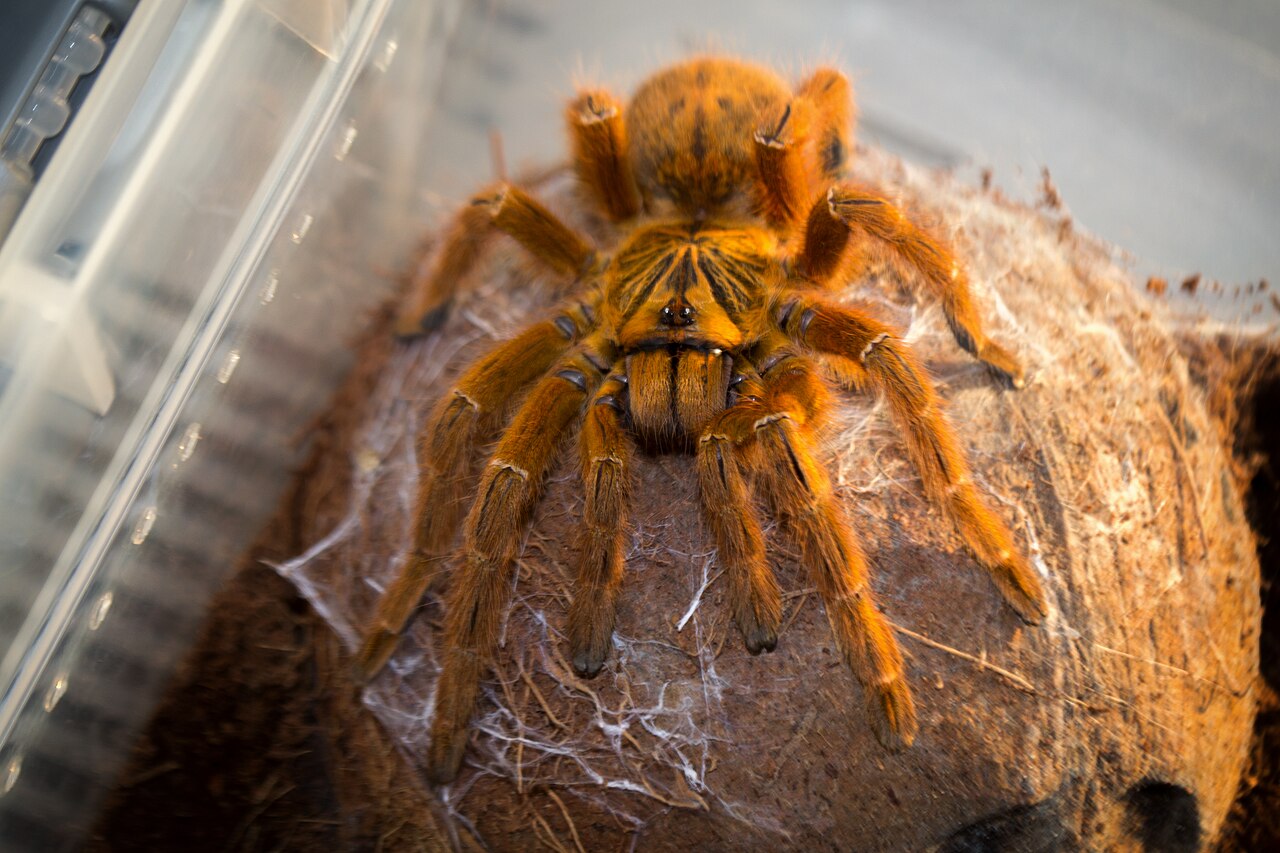
Photo: Антимонов Сергей, CC BY-SA 4.0
Spider
Advanced
Pterinochilus murinus
Lifespan
F 12-15 years, M 3-4 years
Adult size
DLS 10-15 cm
Temperament
Extremely fast and defensive
Temperature
18–28°C
Humidity
40–65%
Vivarium
40 x 30 x 35 cm (fossorial adult, deep substrate)
Wikipedia →
An Old World baboon spider from central, eastern and southern Africa, including Angola, Kenya, Tanzania, Mozambique and Zanzibar, where it digs burrows and builds dense silk tunnels. It is orange to rusty brown depending on the colour form, with a star-shaped pattern on the carapace and a fishbone pattern on the abdomen. Keepers prize its colour, fast growth, hardiness and heavy webbing, but it has no urticating hairs and instead defends itself with very fast bites, often without any threat display, and potent, medically significant venom.
Care information is provided for educational purposes only and does not replace professional veterinary advice.
🔥 Heating
Room temperature of about 20-27°C suits it and it tolerates fluctuations well. If extra heat is needed, use a heat mat on one side of the enclosure (never underneath) controlled by a thermostat. No basking surface is needed.
💡 Lighting
No UVB or special lighting is needed. Keep the enclosure in a room with a normal day and night light cycle and out of direct sunlight.
🪨 Substrate
At least 13-15 cm of dry coco fibre, topsoil or a mix for adults, and 5-8 cm for slings with the bottom layer lightly damp. A 2025 study found these spiders were least likely to flee, rear up or bite when kept with deep substrate, so give plenty of depth.
🍽 Feeding
Feed slings small crickets, roach nymphs or fruit flies twice a week, juveniles every 7-10 days and adults crickets, roaches or locusts every 10-14 days. It eats eagerly but refuses food in premoult, so wait about a week after a moult, and remove uneaten prey with long tongs, never fingers.
💧 Water
Provide a small water dish even though the substrate is kept dry, and check it with tongs because it often webs over the dish or drops food remains in it. If the dish is covered, lightly mist the web about once a week so it can drink.
🏠 Enrichment
Give a cork piece or starter burrow partly buried in deep substrate, plus cork bark or sticks above the surface as anchor points for its webbing. It builds a webbed retreat and may web over most of the enclosure.
🩺 Health Considerations
Hardy. Keep the substrate dry apart from a lightly damp layer for slings, as constantly wet substrate encourages mould and mites, and also watch for stuck moults, dehydration in slings, nematodes (white discharge around the mouthparts) and DKS (jerky, uncoordinated movement).
🤲 Handling
Strictly hands-off. It has no urticating hairs but is extremely fast, often bites without a threat display, and its venom is medically significant: bites cause severe pain and can cause recurring muscle cramps and spasms lasting days, so seek medical advice after any bite. Use long tongs and a catch cup, plan every rehousing in advance (ideally inside a larger tub or bath to contain a bolt) and keep hands away from the open enclosure.
⚖️ Legal Restrictions
No licence needed in the UK. It is not on the Dangerous Wild Animals Act 1976 schedule (as modified in 2007 the only spiders listed are Phoneutria, Atrax, Loxosceles and Latrodectus), is not CITES- or Annex-listed and is not an invasive species, despite its medically significant venom.
📋 Additional Notes
Several locality colour forms are traded, such as RCF (red colour form, Usambara Mountains, Tanzania), DCF (dark colour form) and TCF (typical colour form), all with the same care. Nicknamed OBT ('orange bitey thing'), it grows fast. Mature males are smaller and leggier, with palpal bulbs and tibial hooks, so sexing from a moult avoids handling.