
← Species Repository
Emperor Scorpion
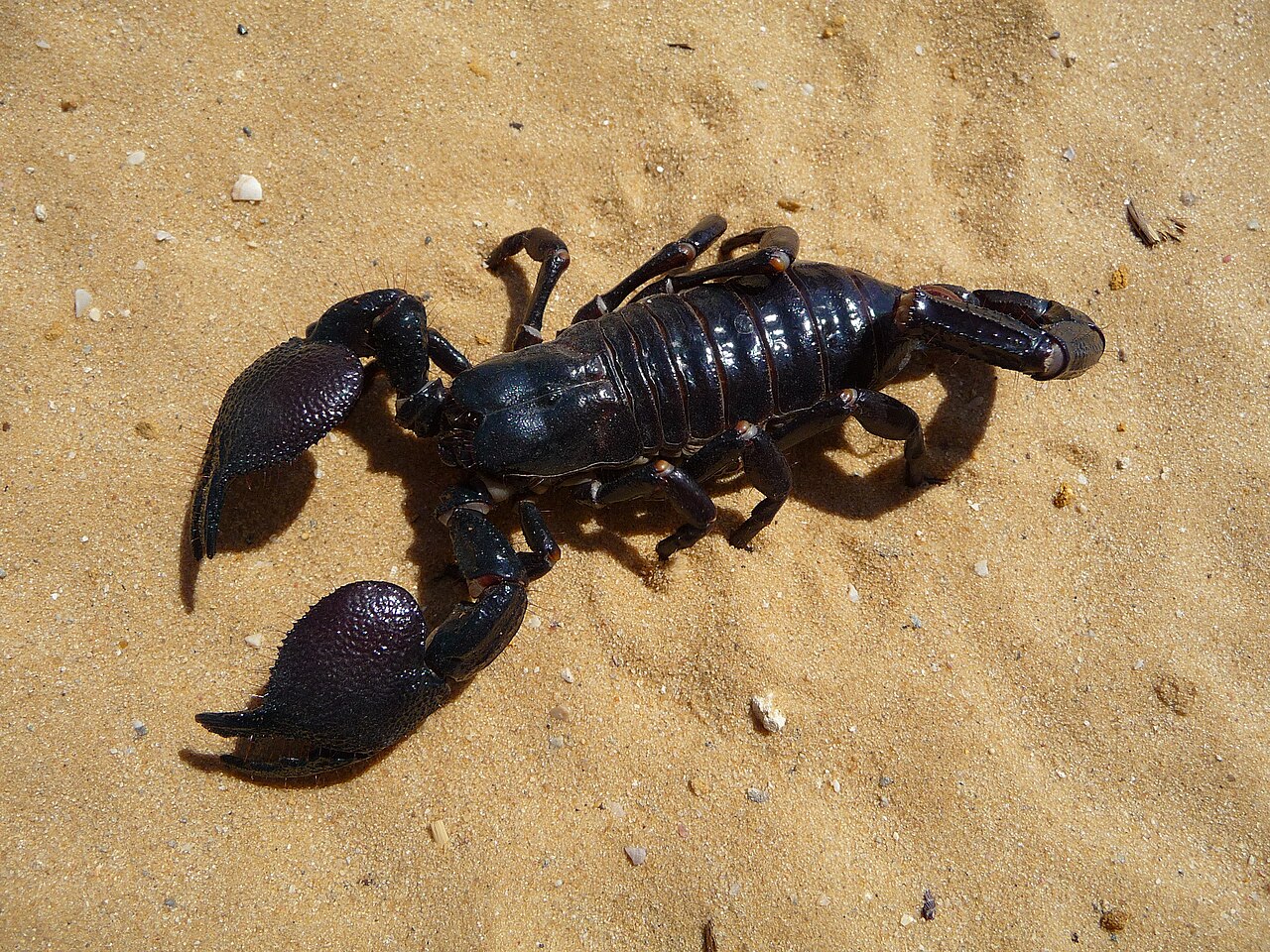
Photo: George Chernilevsky, public domain
Scorpion
Beginner
Pandinus imperator
Lifespan
F 6-8 years, M slightly less
Adult size
Body 15-20 cm
Temperament
Docile, prefers pinching to stinging
Temperature
21–30°C
Humidity
70–85%
Vivarium
50 x 25 x 30 cm (one adult)
Wikipedia →
A large, glossy black scorpion from the rainforest and humid savannah of West Africa, where it burrows under debris and digs into termite mounds. Adults reach about 20 cm and have huge, granular claws. It is the most commonly kept scorpion because it is calm, hardy and slow-moving. Its sting is mild and not medically significant for healthy people, but the claws give a painful pinch and any scorpion sting can trigger an allergic reaction.
Care information is provided for educational purposes only and does not replace professional veterinary advice.
🔥 Heating
Use a heat mat fixed to one side wall and run on a thermostat, never underneath, giving a warm side of about 26-28°C and a cooler side near 22°C. In a warm house room temperature may be enough; a small night drop is fine but keep it above 21°C.
💡 Lighting
No UVB needed. It is nocturnal and avoids bright light, so normal room daylight gives the day/night cycle; a dim red or blue LED can be used for night viewing.
🪨 Substrate
A moisture-holding mix such as coco fibre with topsoil or peat-free compost, 10-15 cm deep so it can burrow. Keep the lower layers damp but not waterlogged, with leaf litter or moss on top to hold humidity.
🍽 Feeding
Scorplings take small crickets or roach nymphs 1-2 times a week, juveniles once a week, and adults a few large crickets or roaches every 7-14 days. Prey should be no bigger than the scorpion's body; remove uneaten prey after 24 hours to prevent mites and mould.
💧 Water
Provide a wide, shallow water dish it can drink from without drowning. Keep humidity up by overflowing the dish now and then or lightly misting one side.
🏠 Enrichment
Give several hides such as cork bark slabs and half logs, deep substrate for burrowing and leaf litter on top. Keep décor low, as falls can injure heavy adults.
🩺 Health Considerations
Watch for dehydration (a shrivelled, wrinkled abdomen), mites from leftover food, and mould or mycosis (dark patches) when wet substrate has poor ventilation. Low humidity can cause failed moults; never disturb a moulting scorpion or leave live prey in with it.
🤲 Handling
Handling is not recommended: falls can crack the exoskeleton and the claws give a painful pinch. The venom is mild and not medically significant for healthy people, but allergic reactions are possible, so move it with soft tongs or a cup.
⚖️ Legal Restrictions
No DWA licence needed in the UK: the Dangerous Wild Animals Act 1976 schedule (as amended in 2007) lists scorpions only as 'Family Buthidae: All species' and Hemiscorpius lepturus. It is listed on CITES Appendix II (Annex B in UK wildlife trade law), so no Article 10 certificate is needed to keep or sell it, but you must be able to show it was obtained lawfully, so keep the seller's captive-bred or import paperwork. It is not on the GB invasive species list.
📋 Additional Notes
Males are slimmer with longer pectines (the comb-like organs under the body); females are bulkier and give birth to live young that ride on the mother's back. Often confused with Asian forest scorpions, which have smoother claws; the trade name Pandinus africanus is an invalid synonym sometimes used to get around CITES rules. Buy captive-bred where possible, as many are still wild-caught.