
← Species Repository
Flat Rock Scorpion
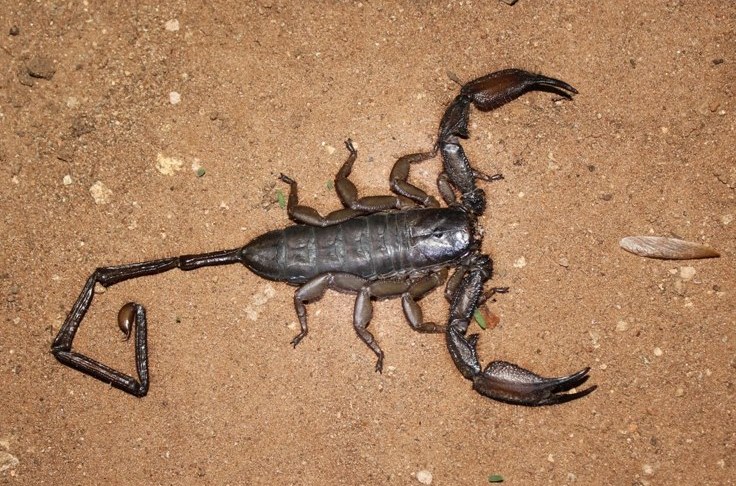
Photo: Maans Booysen, Birding Weto, CC BY-SA 4.0
Scorpion
Intermediate
Hadogenes troglodytes
Lifespan
Long-lived, est. 20+ years
Adult size
Body 15-20 cm (males to 21)
Temperament
Shy and calm, rarely stings
Temperature
21–30°C
Humidity
40–60%
Vivarium
45 x 30 x 30 cm (secured rock stack)
Wikipedia →
A very flat scorpion from dry bushveld rock outcrops in northern South Africa, Botswana, Zimbabwe and Mozambique, where it wedges itself into narrow cracks in granite and sandstone. Males have extremely long, thin tails and can exceed 20 cm, making it one of the longest scorpions. Keepers like its unusual shape, calm nature and long life. The venom is very mild and it rarely stings, defending itself with its claws instead.
Care information is provided for educational purposes only and does not replace professional veterinary advice.
🔥 Heating
Use a heat mat on one side wall run on a thermostat to give a warm side of about 27-29°C and a cooler side near 22-24°C. In a warm room little extra heat is needed; avoid strong overhead lamps.
💡 Lighting
No UVB needed. It is nocturnal and spends the day in crevices, so normal room daylight is enough.
🪨 Substrate
A firm layer 5-10 cm deep of washed sand mixed with soil or coco fibre (about 3:1), mostly dry with one slightly damp area. It needs rock crevices more than burrowing depth.
🍽 Feeding
Juveniles roughly weekly on small crickets or roach nymphs; adults 2-3 prey items every 1-2 weeks. Long fasts of a month or more, especially before a moult, are normal.
💧 Water
Provide a shallow water dish with pebbles, and lightly mist one corner or the rock face about once a week.
🏠 Enrichment
Stack flat slate, cork or tiles to make tight crevices about 1-1.5 cm high, glued with aquarium silicone so they cannot collapse. Keep décor away from the lid, as it climbs and will use any gap to escape.
🩺 Health Considerations
Too much humidity with poor airflow causes mycosis. Moults are slow and leave it soft and vulnerable for days, so do not disturb it or leave prey in; a collapsing rock stack can crush it.
🤲 Handling
Rarely necessary, and pulling it out of a crevice can injure it. The venom is very mild (LD50 1800-2667 mg/kg in mice) and of no medical significance, but the claws give a strong pinch and allergic reactions to any sting are possible.
⚖️ Legal Restrictions
No licence needed in the UK. It is in the Hormuridae, not the Buthidae, so it is not covered by the Dangerous Wild Animals Act 1976 schedule (which lists scorpions only as 'Family Buthidae: All species' and Hemiscorpius lepturus); it is not CITES-listed and not on the GB invasive species list.
📋 Additional Notes
Family Hormuridae (older sources say Ischnuridae or Liochelidae). Males have much longer, thinner tails than females, and animals sold as Hadogenes bicolor are probably H. troglodytes. Most trade animals are wild-caught adults of unknown age; a UV torch helps you check on one deep in a crevice at night.