
← Species Repository
Burmese Python
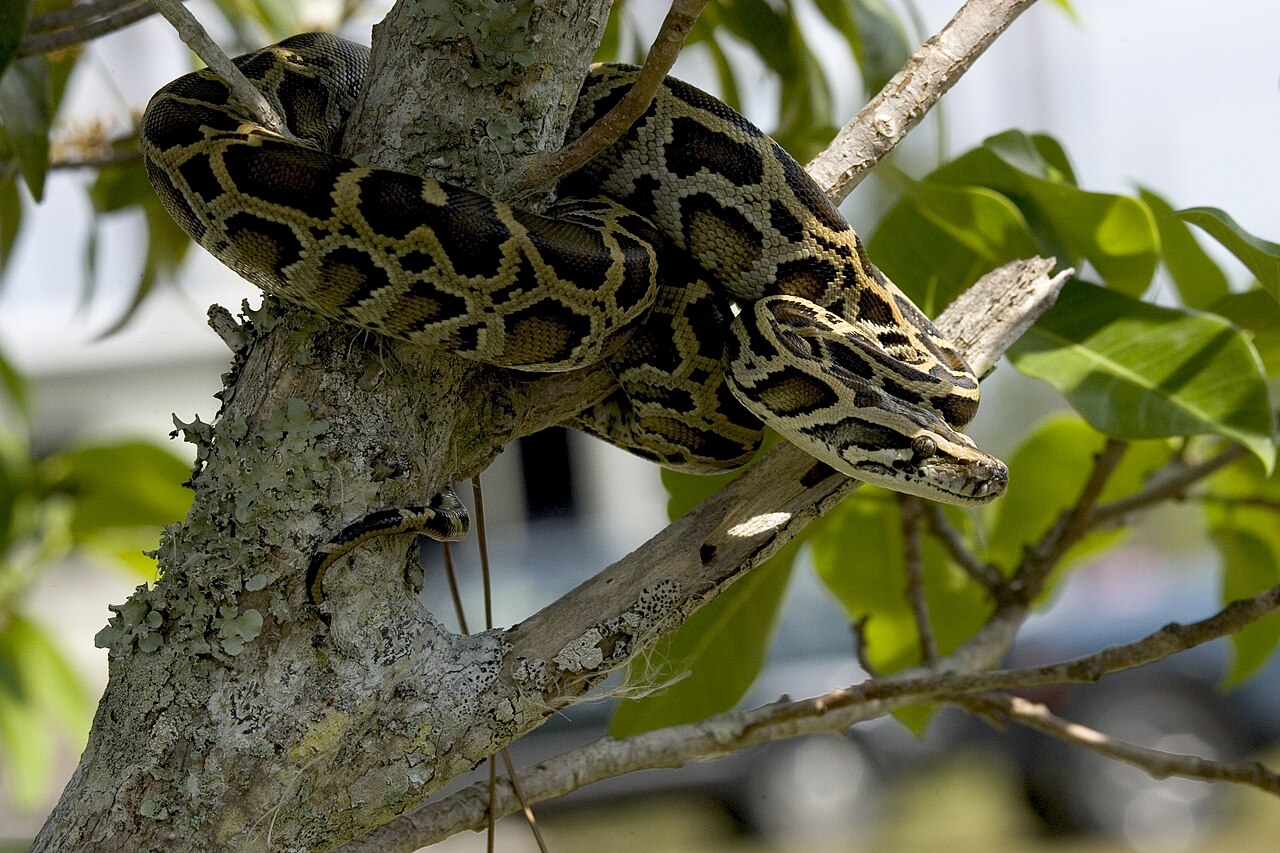
Photo: Rodney Cammauf, Everglades NPS, public domain
Snake
Advanced
Python bivittatus
Lifespan
20-25+ years
Adult size
350-500 cm, females heavier
Temperament
Usually docile, but huge, strong and food-driven
Temperature
24–32°C
Humidity
50–75%
Vivarium
400 x 200 x 120 cm for a 4 m adult (custom build)
Wikipedia →
Native to southern and south-east Asia, from eastern India and Nepal to southern China, Java and Sulawesi, in grassland, marsh, forest and river valleys, usually near water. One of the world's largest snakes, with dark brown blotches on a tan background, and bred in albino, caramel, granite and other morphs. Often docile, but adults commonly reach 3.5-5 m and can weigh well over 50 kg, so they need room-sized housing and an experienced keeper. Released pets have become a major invasive species in Florida.
Care information is provided for educational purposes only and does not replace professional veterinary advice.
🔥 Heating
Use several caged heat lamps and radiant panels on thermostats to give a basking surface of 32-34 °C and a cool end of 26-29 °C. Keep nights no lower than about 24 °C using a lightless heat source.
💡 Lighting
A 12-hour day and night cycle. UVB is recommended for welfare: a T5 tube over half the enclosure giving a UVI of 2-3 where it basks.
🪨 Substrate
A topsoil, coir and sand mix or coconut husk at least 10 cm deep; newspaper is a practical option for very large adults. Avoid letting wood-based substrate stay wet.
🍽 Feeding
Frozen-thawed rats, then rabbits or poultry for large adults, about 1-1.5 times the snake's girth. Hatchlings every 1-2 weeks, juveniles every 2-3 weeks, young adults every 3-4 weeks and adults over 4 years every 4-6 weeks. Power-feeding causes obesity and shortens life.
💧 Water
A water container big enough to coil and soak in, changed weekly or whenever soiled. Mist to keep humidity around 60%, letting the enclosure dry between mistings.
🏠 Enrichment
Large hides (a plastic dog kennel works), sturdy secured logs and platforms, and ideally a pool to swim in. Space and varied décor help prevent obesity and boredom.
🩺 Health Considerations
Obesity from overfeeding is very common. Respiratory infections follow wet or cold conditions; also watch for burns from unguarded heaters, mites, stuck sheds and spinal injury from lifting by the tail. Quarantine new animals for at least 3 months.
🤲 Handling
Never handle or feed a snake over about 3 m alone: have at least one other person present. Never let it coil around your neck, and use a hook or tap-training so it can tell handling from feeding. Non-venomous, but a feeding bite and constriction from a large adult can kill.
⚖️ Legal Restrictions
No Dangerous Wild Animals licence is needed in the UK, as the 1976 Act schedule covers only venomous snakes. It is CITES Appendix II (UK Annex B): keep proof of captive-bred origin. Releasing non-native animals into the wild is an offence.
📋 Additional Notes
Females become much heavier than males; probe to confirm sex. Morphs include albino, caramel, leucistic, granite and labyrinth, and dwarf forms from Java, Bali, Sumbawa and Sulawesi reach about 2.5 m. Formerly Python molurus bivittatus; the Indian python (Python molurus molurus) is Appendix I and needs an Article 10 certificate.