
← Species Repository
Mexican Red-knee Tarantula
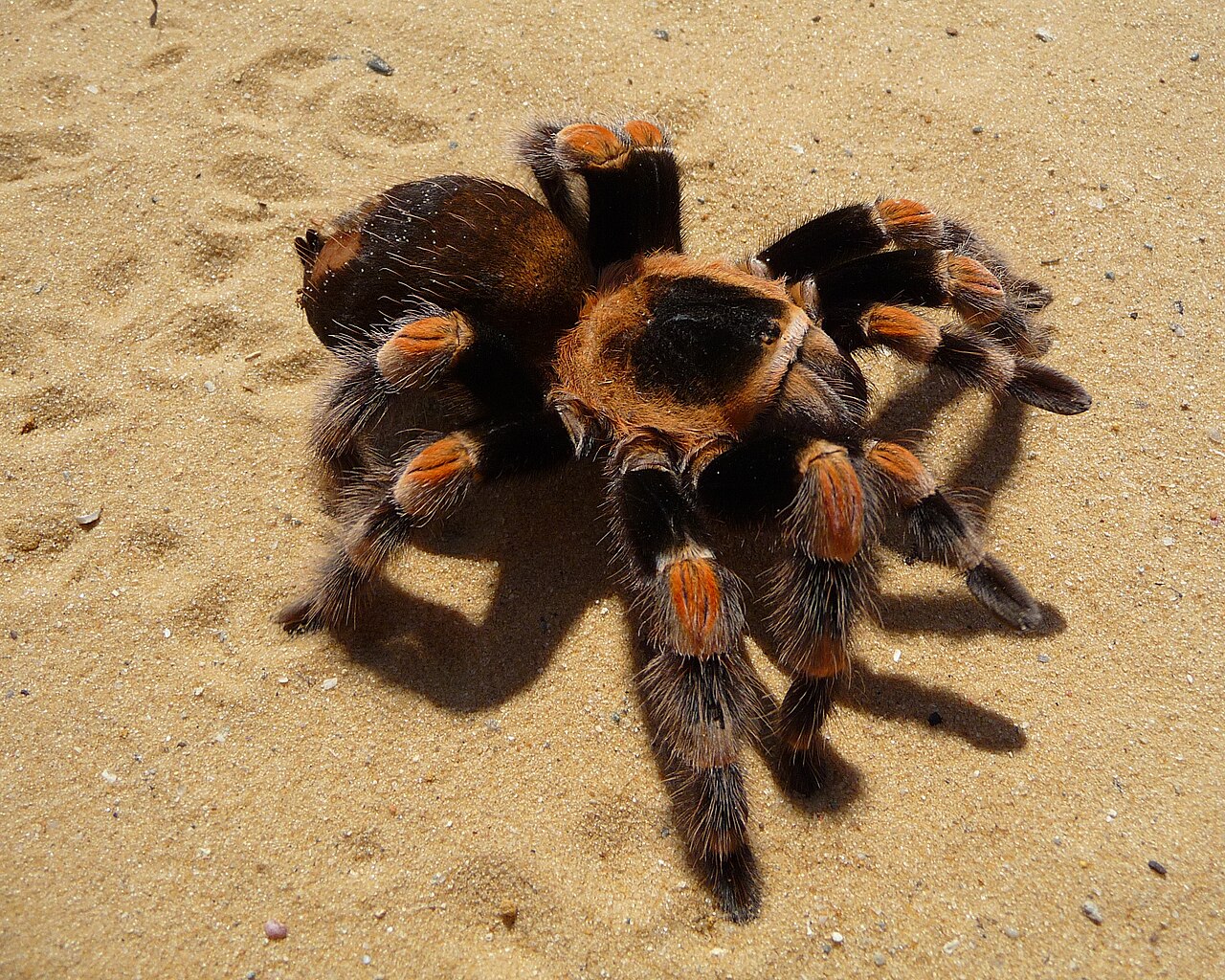
Photo: George Chernilevsky, public domain
Spider
Beginner
Brachypelma hamorii
Lifespan
F 25-30 years, M 5-10 years
Adult size
DLS 13-15 cm
Temperament
Calm but flicks urticating hairs
Temperature
18–28°C
Humidity
40–70%
Vivarium
45 x 30 x 30 cm (terrestrial adult)
Wikipedia →
Native to the Pacific slopes of the Sierra Madre Occidental and Sierra Madre del Sur in Colima, Jalisco and Michoacán, Mexico, where it burrows under logs, rocks and roots in dry deciduous forest. A heavy-bodied black tarantula with bright orange-red leg bands, it is one of the most recognisable and long-lived pet spiders and is usually calm. It kicks urticating hairs when disturbed, and wild populations are listed as Vulnerable by the IUCN.
Care information is provided for educational purposes only and does not replace professional veterinary advice.
🔥 Heating
Room temperature of about 20-25°C is enough in most UK homes, so heating is not normally needed. If the room regularly falls below 18°C, fit a small heat mat to one side of the enclosure (never underneath) on a thermostat so the spider can move away from the warmth. No basking spot or heat lamp is needed.
💡 Lighting
No UVB or special lighting is needed. Keep it in a room with a normal day and night cycle and out of direct sunlight, which can overheat the enclosure quickly.
🪨 Substrate
Coco fibre or a coco fibre and topsoil mix at least 10 cm deep, kept mostly dry with one corner slightly damp, as it can suffer if kept too moist. Keep the drop from the substrate surface to the lid no more than about 1.5 times the leg span, as this heavy-bodied spider is easily hurt by falls.
🍽 Feeding
Feed slings small crickets or roach nymphs once or twice a week, juveniles every 7-10 days and adults several large crickets, locusts or a couple of large roaches every 2-4 weeks. Adults often refuse food for weeks before a moult, so remove uneaten prey within 24 hours and wait about a week after moulting before feeding again.
💧 Water
Keep a shallow water dish filled from about 2.5 cm leg span and overflow it into one corner occasionally. Smaller slings can have a few drops of water on one corner of the substrate weekly instead.
🏠 Enrichment
Provide a cork bark hide with a starter burrow dug beneath it, and it will usually line the entrance with silk. Adults often sit out at the burrow mouth, making it a good display species.
🩺 Health Considerations
Very hardy if kept on the dry side with fresh water always available. Watch for dehydration, bad moults, falls, and mould or mites on damp, stagnant substrate, while jerky uncoordinated movement (DKS) needs specialist advice.
🤲 Handling
Hands-off is recommended, as it readily kicks urticating hairs that can irritate or swell skin and injure eyes, and even a short fall can rupture its abdomen. Use tongs and a catch cup, wash your hands after maintenance, never rub your eyes and wear eye protection when rehousing. The bite is painful and the large fangs can leave punctures that may become infected, but the venom is not medically significant, though allergic reactions are possible.
⚖️ Legal Restrictions
No Dangerous Wild Animals Act licence is needed (no tarantulas are on the 2007 schedule) and it is not a UK invasive species. It is listed in CITES Appendix II and Annex B of the UK Wildlife Trade Regulations, so no Article 10 certificate is needed to keep or sell it, but keep proof of legal, captive-bred acquisition. Import or export across the UK border needs CITES permits.
📋 Additional Notes
Brachypelma hamorii was long confused with and sold as B. smithi until Mendoza and Francke (2017) separated the two using DNA barcodes and differences in the male palpal bulb and female spermatheca, so most older hobby animals labelled B. smithi are this species, and care is the same. Sex from a moult (spermatheca) or the ventral epigastric furrow, and mature males develop palpal bulbs and tibial hooks. Growth is slow to medium, and with females living up to 30 years it is a long-term commitment.