
← Species Repository
Arizona Bark Scorpion
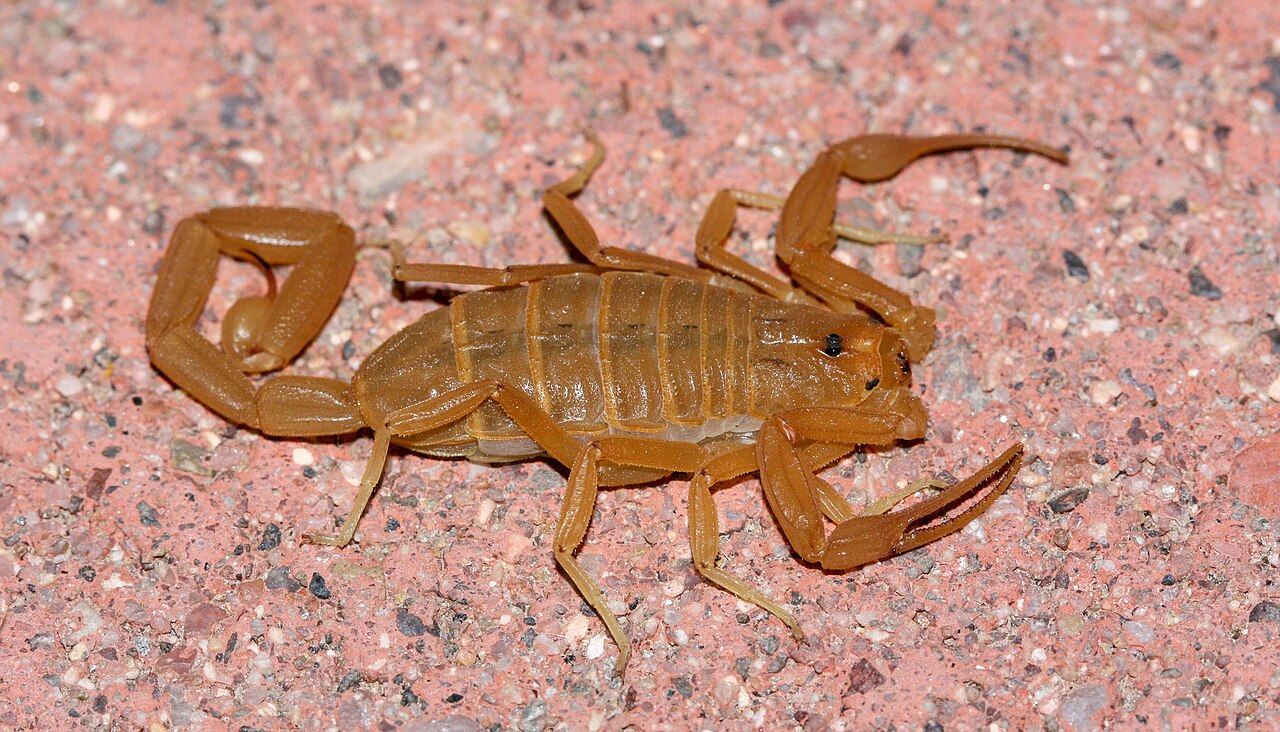
Photo: Andrew Meeds, CC BY 4.0
Scorpion
Advanced
Centruroides sculpturatus
Lifespan
F 5-7 years, M 3-4 years
Adult size
Body 5-8 cm
Temperament
Nervous, fast, excellent climber
Temperature
20–30°C
Humidity
30–50%
Vivarium
30 x 20 x 30 cm (tall, lockable lid)
Wikipedia →
A small, slender, yellowish-tan buthid from the south-western USA (Arizona, southern California, Nevada, Utah and New Mexico) and north-western Mexico, often found under bark and in houses. Adults reach 7-8 cm. It is popular in the US because it is easy to keep and can live in groups, but it is the most venomous scorpion in the United States. Stings cause severe pain and numbness lasting 1-3 days and can be dangerous to children and older people.
Care information is provided for educational purposes only and does not replace professional veterinary advice.
🔥 Heating
Keep it at 24-29°C with a slight gradient, never for long below 18°C or above 35°C, using a heat mat on one side wall run on a thermostat if needed.
💡 Lighting
No UVB needed; it is nocturnal, and normal room daylight gives the day/night cycle.
🪨 Substrate
About 5 cm of coco fibre and sand, mostly dry with one small damp corner; the depth also cushions falls.
🍽 Feeding
Juveniles small prey once or twice a week; adults 2-3 crickets once or twice a week, with slightly more prey than scorpions in a group. Remove leftovers.
💧 Water
Provide a small, shallow dish and avoid heavy misting, as too much moisture is riskier than too little.
🏠 Enrichment
Lean several pieces of cork bark against the walls for climbing and hiding; it likes to hang upside down, including under the lid.
🩺 Health Considerations
Crowded groups lead to aggression and cannibalism, so separate injured animals. Escape is the main danger, as it climbs glass and plastic.
🤲 Handling
Never handle it; use long tongs and always find the scorpion, which often sits under the lid, before opening the enclosure. The neurotoxic venom causes intense pain, numbness and muscle twitching and can cause serious symptoms in children, so get urgent medical help for any sting.
⚖️ Legal Restrictions
DWA licence needed: the Dangerous Wild Animals Act 1976 schedule lists 'Family Buthidae: All species' (England and Wales as substituted by SI 2007/2465, Scotland by SSI 2008/302), and the Dangerous Wild Animals (Northern Ireland) Order 2004 lists all Buthidae too. Get the licence from your local council before you acquire one. It is not CITES-listed and not on the GB invasive species list.
📋 Additional Notes
Formerly included in Centruroides exilicauda. It glows strongly under UV, so a UV torch is the best way to locate it inside the enclosure or if it escapes. In the US an antivenom (Anascorp) is approved for severe stings.