
← Species Repository
Blue Forest Scorpion
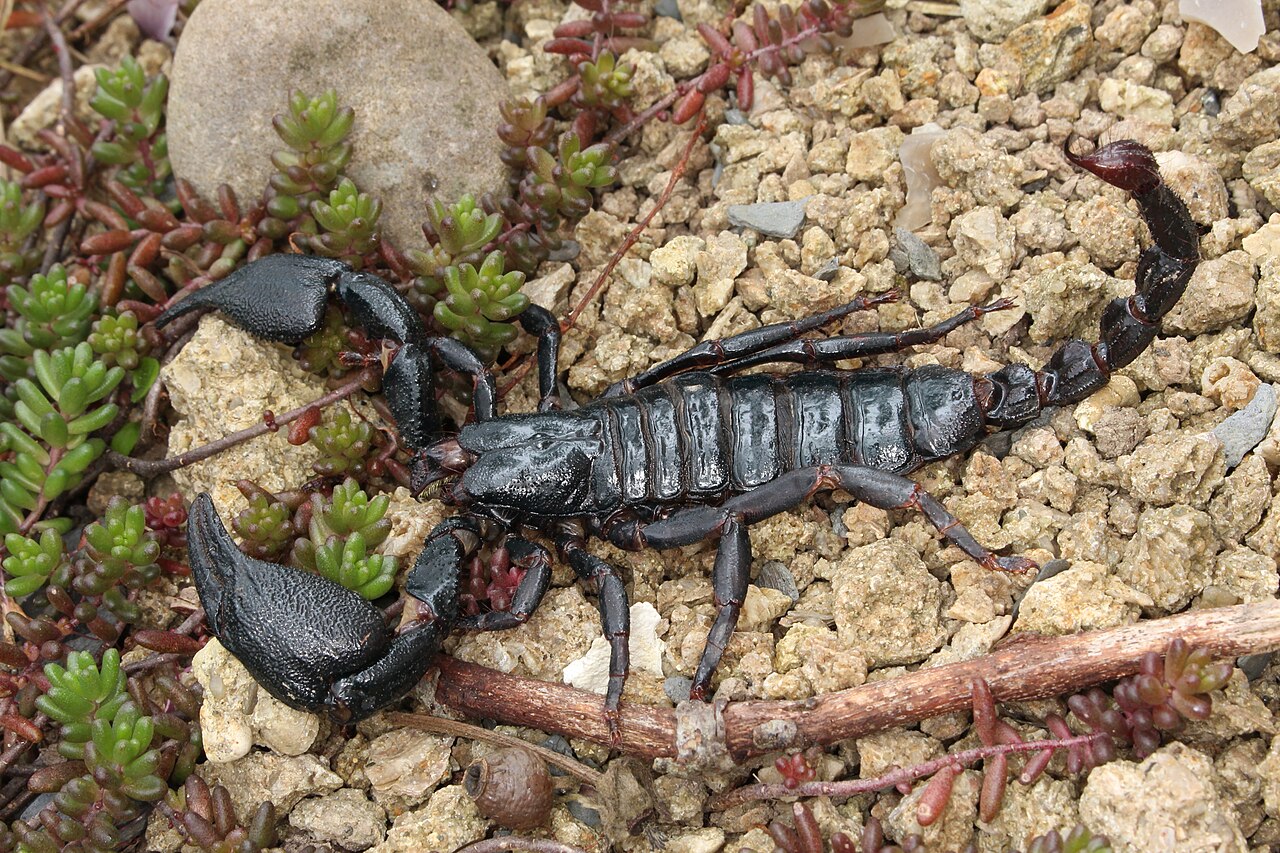
Photo: Holger Krisp, CC BY 4.0
Scorpion
Beginner
Javanimetrus cyaneus
Lifespan
7-9 years
Adult size
Body 12-15 cm
Temperament
Nervous and defensive
Temperature
21–29°C
Humidity
70–85%
Vivarium
45 x 30 x 30 cm (one adult)
Wikipedia →
A big forest scorpion from tropical rainforest and wetland forest in Borneo, the Philippines and Indonesia, where it hides under stones and fallen logs. Adults reach 12-15 cm and are black with a blue sheen and heavily granulated bodies. It is sold in the UK as a larger, more colourful alternative to other Asian forest scorpions. The sting can cause moderate to severe local pain but is not considered medically significant for healthy people.
Care information is provided for educational purposes only and does not replace professional veterinary advice.
🔥 Heating
Keep it at 25-28°C by day and 21-23°C at night, using a heat mat on one side wall run on a thermostat if the room is cooler.
💡 Lighting
No UVB needed. Avoid bright light, as it is nocturnal; ordinary room daylight gives the day/night cycle.
🪨 Substrate
10-15 cm of coco fibre, peat-free compost or a soil mix, kept slightly moist but not waterlogged.
🍽 Feeding
Juveniles every 3-4 days; adults 1-2 large crickets, roaches or locusts a week. Prey should be no wider than its body; remove leftovers after 24 hours.
💧 Water
Keep a shallow water dish available at all times, and mist lightly daily or every other day to hold humidity at 70-80%.
🏠 Enrichment
Cork bark, hollow logs or rock hides and leaf litter, with substrate deep enough to burrow in.
🩺 Health Considerations
Moulting problems follow if humidity drops, and mould and mycosis develop if it is wet and poorly ventilated. Wild-caught animals may carry mites, so quarantine new arrivals.
🤲 Handling
Best kept hands-off: it is nervous, nips hard enough to break skin, and the sting is painful. It is not medically significant for healthy people, but allergic reactions are possible.
⚖️ Legal Restrictions
No licence needed in the UK. It is in the Scorpionidae, not the Buthidae, so it is not covered by the Dangerous Wild Animals Act 1976 schedule (which lists scorpions only as 'Family Buthidae: All species' and Hemiscorpius lepturus); it is not CITES-listed and not on the GB invasive species list.
📋 Additional Notes
Still widely sold as Heterometrus cyaneus (synonyms include Buthus cyaneus and Pandinus indicus); the current name is Javanimetrus cyaneus. The blue sheen is strongest in adults. Separate young after their first moult to prevent cannibalism.