
← Species Repository
Regal Jumping Spider
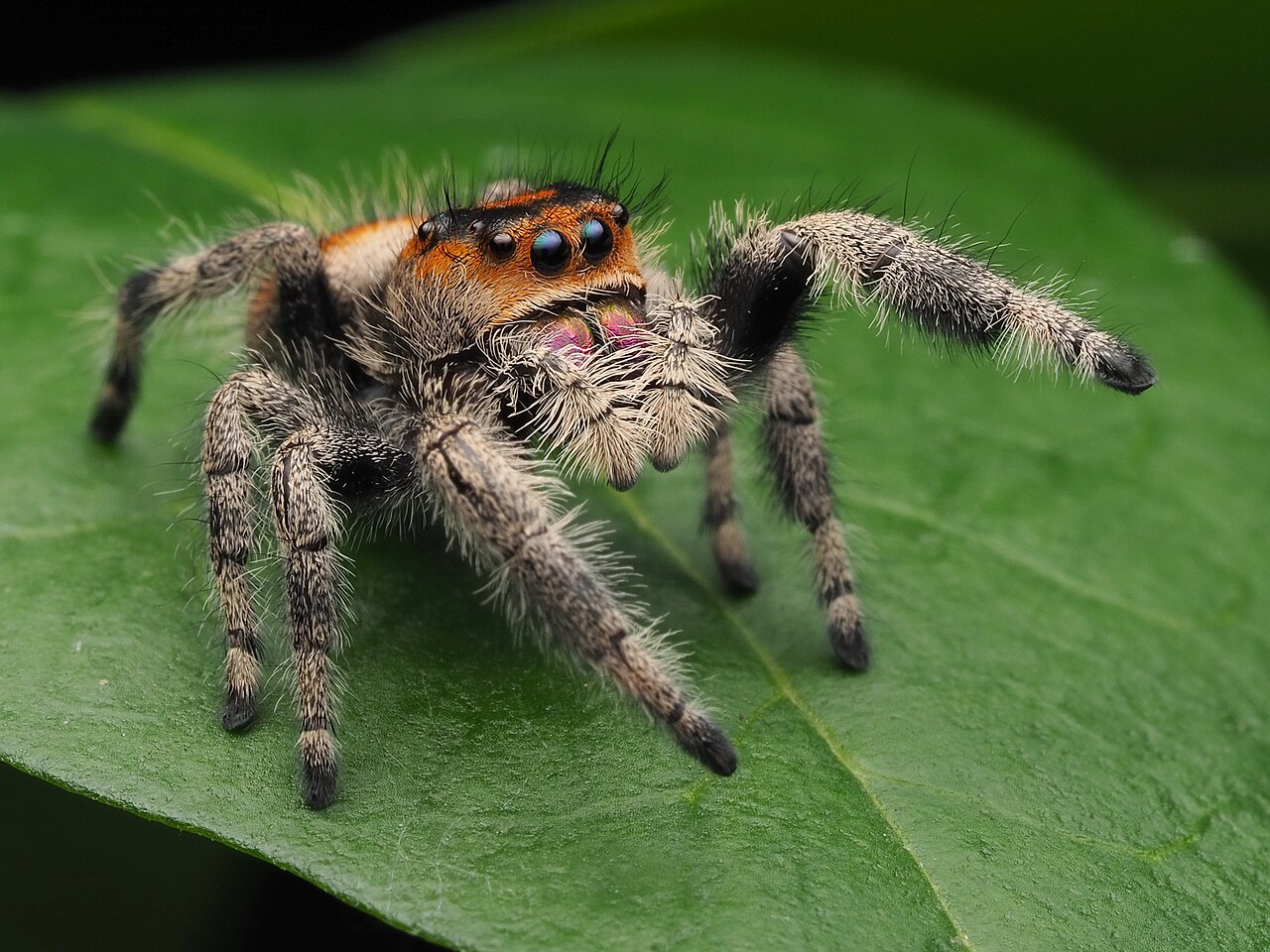
Photo: spidereyes2020, CC0
Spider
Beginner
Phidippus regius
Lifespan
F 1.5-3 years, M about 1 year
Adult size
Body F 15-22 mm, M 12-18 mm
Temperament
Curious and calm, rarely bites
Temperature
20–27°C
Humidity
50–75%
Vivarium
20 x 20 x 30 cm (arboreal, taller than wide)
Wikipedia →
Native to the south-eastern United States (especially Florida), the Bahamas and the Greater Antilles, where it hunts on tree trunks, palms and walls in fields and open woodland. It is the largest jumping spider in eastern North America: adult males are black with white markings and iridescent green-blue chelicerae, while females range from grey and tan to bright orange. Keepers love its curiosity, excellent eyesight and interactive behaviour, and many captive-bred locality forms are available. Bites are rare and not medically significant, though they can be painful.
Care information is provided for educational purposes only and does not replace professional veterinary advice.
🔥 Heating
Normal room temperature of about 21-26 °C is ideal and no extra heat is usually needed. In a cold room, warm the room or fit a small heat mat to the side of the enclosure on a thermostat; avoid heat lamps and under-floor mats, which overheat and dry out small enclosures.
💡 Lighting
A daytime hunter that relies on its eyesight, so give a regular day/night cycle of about 10-12 hours of bright light from room daylight or a small LED panel. No UVB is required; keep the enclosure out of direct sun.
🪨 Substrate
A thin layer (2-5 cm) of coco fibre or a soil and coco mix, kept very lightly moist, never wet. It lives off the ground, so substrate is mainly there to hold a little humidity and support live plants.
🍽 Feeding
Spiderlings: flightless fruit flies or pinhead crickets every 2-4 days. Juveniles: small crickets, flies or roach nymphs every 3-7 days; adults: flies, crickets or small roaches once or twice a week, adjusted so the abdomen stays no wider than the carapace. Remove uneaten prey within 24 hours, especially before a moult.
💧 Water
Lightly mist one side of the enclosure or the decor every 2-3 days so the spider can drink droplets, letting it dry between mistings. Larger juveniles and adults can also use a very shallow water dish placed up high.
🏠 Enrichment
Plenty of vertical cork bark, twigs and live or artificial plants with anchor points near the top, where it spins a silk sleeping retreat. A front-opening enclosure with cross-ventilation suits it best.
🩺 Health Considerations
The main problems are dehydration (especially in spiderlings), mould from stagnant damp air, overfeeding and failed moults. A spider that seals itself into a thick silk retreat is usually preparing to moult, so leave it alone and do not feed it until it has come out and hardened for a few days.
🤲 Handling
Usually calm and more likely to jump away than bite, so gentle hand-walking low over a soft surface is possible; a fall is a bigger danger than a bite. The bite is rare and not medically significant, though it can cause local pain and swelling.
⚖️ Legal Restrictions
No licence needed in the UK. It is not on the Dangerous Wild Animals Act 1976 schedule (which lists only Phoneutria, Atrax, Loxosceles and Latrodectus spiders), is not CITES-listed and is not a GB invasive species of special concern. As a non-native animal it must never be released (Wildlife and Countryside Act 1981, section 14).
📋 Additional Notes
Sexing: adult males are black and white with iridescent chelicerae and fringed front legs, while females are larger, covered in grey, tan or orange scales. Many locality forms are bred, such as Florida, Everglades, Bahamas, Soroa and Isla de la Juventud (Cuba) and Sierra de Bahoruco (Hispaniola), and colour varies with locality. Keep singly, as females may eat males; size varies widely (Wikipedia gives males 6-18 mm and females 7-22 mm).