
← Species Repository
Rosy Boa
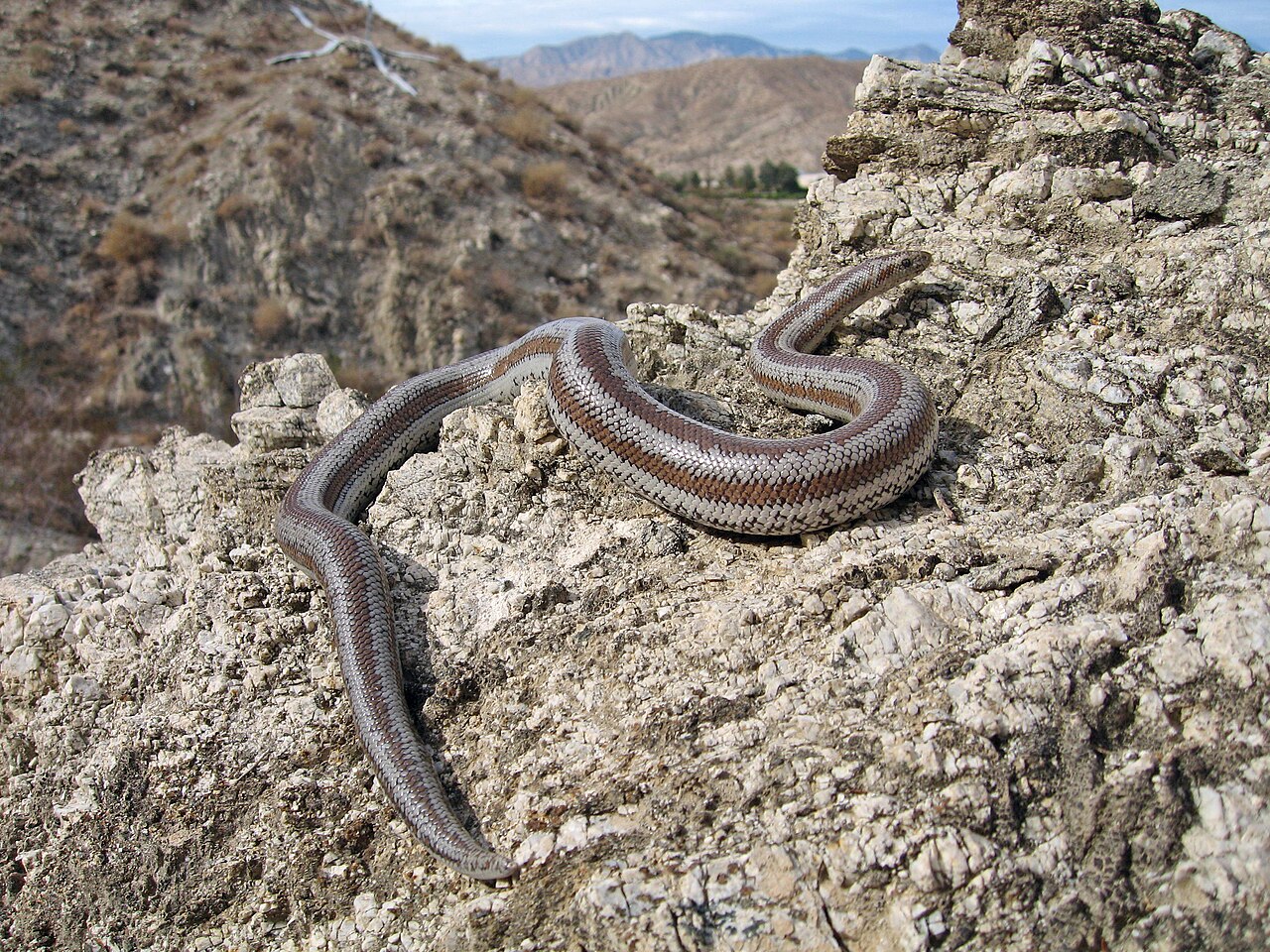
Photo: Robb Hannawacker, Joshua Tree National Park, public domain
Snake
Beginner
Lichanura trivirgata
Lifespan
25-30+ years
Adult size
60-90 cm (max about 110 cm)
Temperament
Very docile and slow-moving
Temperature
18–30°C
Humidity
20–60%
Vivarium
90 x 45 x 45 cm (adult)
Wikipedia →
Found in the deserts and rocky scrub of the south-western United States and north-western Mexico, often among granite outcrops. A small, stout boa with three lengthwise stripes of orange, maroon, brown or black on a grey, cream or yellow background, varying by locality. Keepers prize its gentle temperament, small size and long life. It is one of the easiest boas to keep but must be kept dry.
Care information is provided for educational purposes only and does not replace professional veterinary advice.
🔥 Heating
Use a halogen basking lamp on a thermostat at one end, giving a basking surface of 29-32 °C and a cool end of 24-27 °C. Heating can go off at night and temperatures can fall to around 18 °C. Many keepers brumate adults at about 13 °C for a couple of months in winter.
💡 Lighting
A 12-hour day and night cycle, or a seasonal cycle. It is nocturnal, but low-output UVB giving a UVI of 2-3 at the basking spot is beneficial.
🪨 Substrate
Sand, a sandy soil and clay mix or aspen, at least 8-10 cm deep and kept dry. Avoid cedar and dusty beddings.
🍽 Feeding
Frozen-thawed mice no wider than 1.5 times the snake's widest point. Juveniles every 5-7 days and adults every 10-14 days, with no food during brumation. Fast for about two weeks before cooling so the gut is empty.
💧 Water
A small bowl of fresh water, scrubbed weekly. Keep the vivarium dry, with a humid hide only around shed time, as damp conditions make it unwell.
🏠 Enrichment
Two tight hides, rocks bedded firmly on the floor, cork flats and low branches. It likes to squeeze into crevices and burrow.
🩺 Health Considerations
Snout rubbing on mesh lids, regurgitation if handled too soon after feeding, illness from damp conditions, obesity, and food rotting in the gut if it is cooled before digesting. Quarantine new animals for up to 6 weeks.
🤲 Handling
One of the calmest snakes to handle and bites are rare. Touch it with a hook or tongs first so it does not mistake your hand for food, support it with both hands and let it move freely. Non-venomous.
⚖️ Legal Restrictions
No Dangerous Wild Animals licence needed in the UK. As a boa it is CITES Appendix II (UK Annex B): keep proof of captive-bred origin; no certificate is needed for captive-bred pets.
📋 Additional Notes
Usually sold by locality, such as Mexican, desert, Baja and coastal, plus albino, anerythristic and hypomelanistic lines. Coastal and northern populations are often treated as a separate species, Lichanura orcutti, with identical care; formerly Charina trivirgata. Males have longer tails and larger spurs; probe to confirm sex.