
← Species Repository
Indian Ornamental Tarantula
Spider
Advanced
Poecilotheria regalis
Lifespan
F 12-15 years, M 3-5 years
Adult size
DLS 15-18 cm
Temperament
Nervous, extremely fast, bites if cornered
Temperature
20–28°C
Humidity
60–80%
Vivarium
30 x 30 x 45 cm (arboreal adult, cross-ventilated)
Wikipedia →
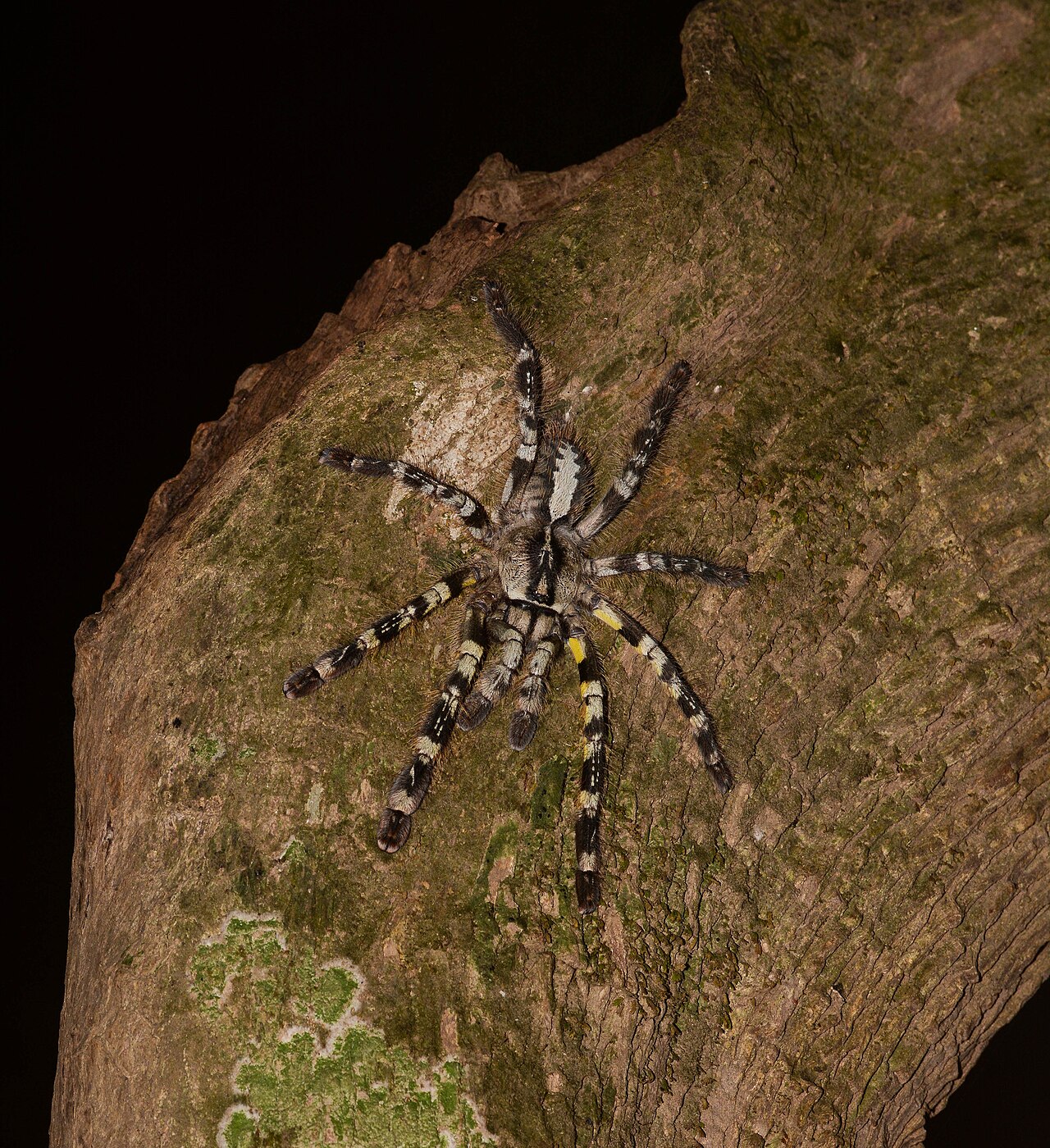
An arboreal Old World tarantula from southeastern India, where it lives in holes in tall trees and spins asymmetric funnel webs. It has an intricate fractal-like pattern and bright patches under the front legs that it flashes in threat displays. Hardy and fast-growing, it is one of the most popular Poecilotheria, but it is extremely fast and has a potent, medically significant bite.
Care information is provided for educational purposes only and does not replace professional veterinary advice.
🔥 Heating
Normal UK room temperature of about 22-26°C is usually enough. If the room regularly drops below about 20°C, use a heat mat on the side of the enclosure (not underneath) on a thermostat. No basking spot or heat lamp is needed.
💡 Lighting
Tarantulas need no UVB or special lighting, and a normal room day and night cycle is fine. Keep the enclosure out of direct sunlight to prevent overheating.
🪨 Substrate
About 5-8 cm of coco fibre or a coco fibre and topsoil mix, kept slightly moist lower down and drier on top. Height and airflow matter more than substrate depth for this tree-dweller.
🍽 Feeding
Feed slings small prey twice a week, juveniles every 7-10 days and adults several large crickets, locusts or a roach every 1-3 weeks according to abdomen size. It takes large prey readily but refuses food in premoult, so wait about a week after an adult moult and remove uneaten prey within 24 hours.
💧 Water
Always provide a water dish, either on the floor or on a ledge it can reach. Lightly mist or dribble water onto the substrate or walls about once a week and let the surface dry between waterings, avoiding stagnant damp.
🏠 Enrichment
Provide a tall cork bark tube or slab fixed upright or at about 45 degrees as its retreat, with extra cork, branches and artificial plants as silk anchors. It builds a silk-lined retreat behind the bark and is most active at night.
🩺 Health Considerations
Slings dehydrate quickly if kept too dry, while stagnant, wet enclosures lead to mould and mites, so balance moisture with good cross-ventilation. Its speed makes escapes during maintenance the most common serious problem.
🤲 Handling
Strictly hands-off. It has no urticating hairs, but it is extremely fast and its venom is medically significant: verified Poecilotheria bites reviewed by Fuchs et al. (2014) caused severe pain and delayed muscle cramps lasting days, so seek medical advice after any bite. Tap the enclosure before opening so it retreats, and use long tongs and a catch cup for all maintenance.
⚖️ Legal Restrictions
No Dangerous Wild Animals Act licence is needed, as no tarantula is on the 1976 Act schedule as amended in 2007, and it is not on any UK invasive species list. All Poecilotheria are CITES Appendix II (since 26 November 2019) and Annex B under the UK Wildlife Trade Regulations, so no Article 10 certificate is needed to keep or sell it in the UK, but keep proof of legal captive-bred acquisition. Moving it across the UK border needs CITES permits.
📋 Additional Notes
Sex by examining moults, as mature males are smaller, slimmer and leggier with palpal bulbs, and like all Poecilotheria they lack tibial hooks. Growth is fast, with maturity in roughly 1.5-3 years, and Ornithoctonus gadgili is a synonym. The IUCN assessed it as Least Concern in 2008, but a 2024 reassessment of Indian tarantulas recommended moving it to a higher threat category.