
← Species Repository
Reticulated Python
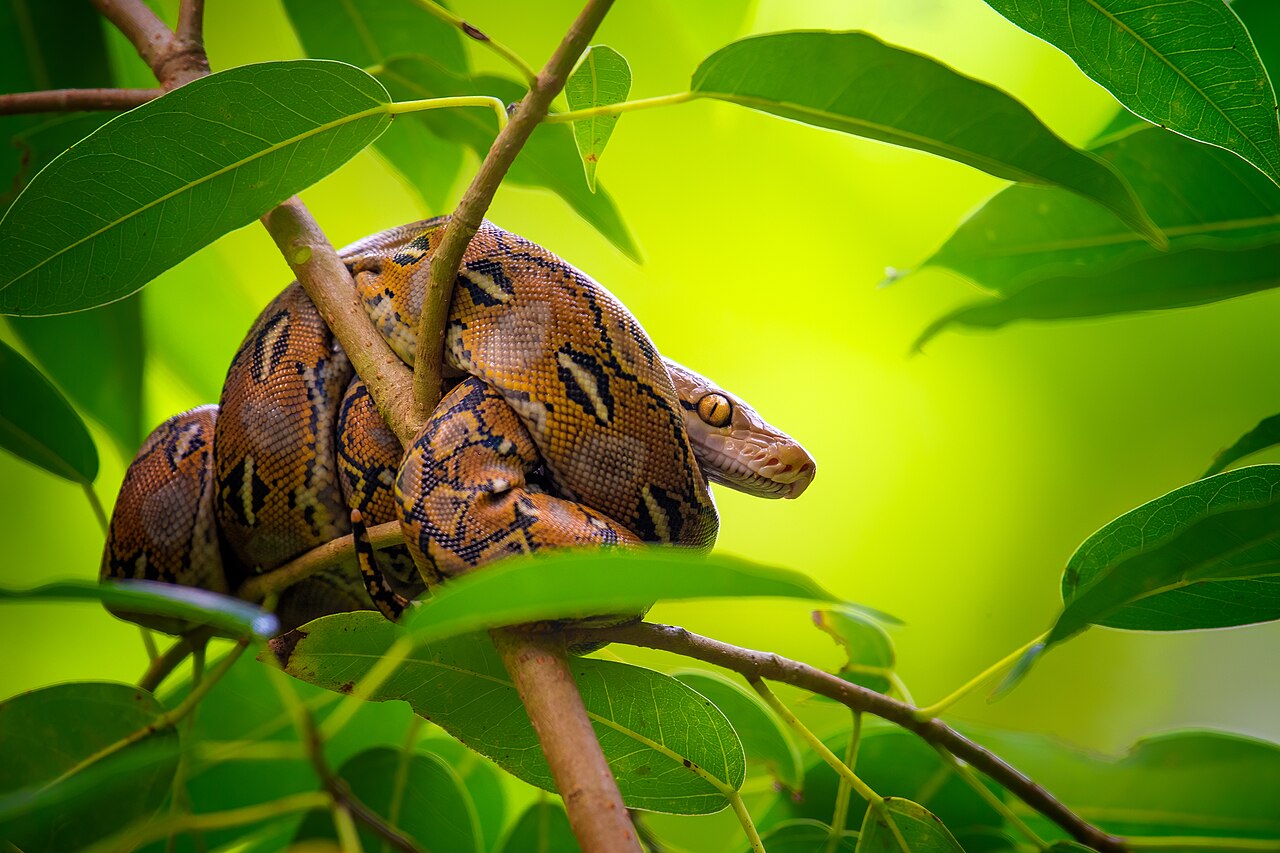
Photo: Kirkamon A. Cabello, CC BY-SA 4.0
Snake
Advanced
Malayopython reticulatus
Lifespan
15-30 years
Adult size
150-600 cm (locality dependent)
Temperament
Intelligent and active; can be unpredictable
Temperature
23–32°C
Humidity
60–80%
Vivarium
240 x 120 x 120 cm (super dwarf); larger for others
Wikipedia →
Ranges across south and south-east Asia, from the Nicobar Islands and India through Indonesia to the Philippines and Timor-Leste, in rainforest, woodland and grassland near water. The world's longest snake, with a complex net-like pattern of black, gold and white, and bred in many morphs such as albino and tiger. Mainland animals can exceed 6 m and have killed people, so only experienced large-constrictor keepers should consider them. Dwarf and super dwarf island localities stay much smaller, at roughly 1.5-4 m.
Care information is provided for educational purposes only and does not replace professional veterinary advice.
🔥 Heating
Use several caged halogen lamps plus a radiant panel on thermostats, giving a basking surface of 31-34 °C and a cool end of 24-26 °C. Keep nights at 23-25 °C with the radiant panel.
💡 Lighting
A 12-hour day and night cycle. UVB is recommended: a T5 tube over half the enclosure giving a UVI of 2-3 at the basking area, plus bright general lighting.
🪨 Substrate
A topsoil, coir and sand mix or coconut husk at least 10 cm deep, or newspaper for very large adults.
🍽 Feeding
Frozen-thawed rodents, then rabbits or poultry, sized to about 1-1.5 times the snake's girth. Hatchlings every 7 days, juveniles every 1-2 weeks, subadults every 2-3 weeks and adults every 4-6 weeks. Avoid power-feeding, which causes obesity and organ strain.
💧 Water
A large, deep water container to soak and ideally swim in, changed weekly or when soiled. Mist at least 2-3 times a day to hold humidity at 60-80%, letting the enclosure dry between mistings.
🏠 Enrichment
Retics are active and curious: provide hollow logs, sturdy branches, platforms and hides, and change the layout regularly. Undersized enclosures lead to nose-rubbing and glass-pushing.
🩺 Health Considerations
Obesity from overfeeding, poor or patchy sheds from low humidity, burns from unguarded heaters and regurgitation of oversized meals. Some morph lines (including certain jaguar and BEL lines) are linked to health problems.
🤲 Handling
Use a two-person rule for any snake over about 3 m and have a second person present at feeding. Tap-train before handling, never let it wrap round your neck and never lift by the tail. Non-venomous, but large retics can inflict serious bites and fatal constriction.
⚖️ Legal Restrictions
No Dangerous Wild Animals licence is needed in the UK, as the 1976 Act schedule covers only venomous snakes. It is CITES Appendix II (UK Annex B): keep proof of captive-bred origin. Releasing non-native animals into the wild is an offence.
📋 Additional Notes
Females grow much longer and heavier than males; probe to confirm sex. Popular localities are super dwarfs (Karompa, Kalaotoa, Madu, Tombolongan, 1.5-3 m) and dwarfs (Jampea, Selayar, Kayuadi, 2.4-4 m). Formerly Python reticulatus.