
← Species Repository
Pantropical Huntsman Spider
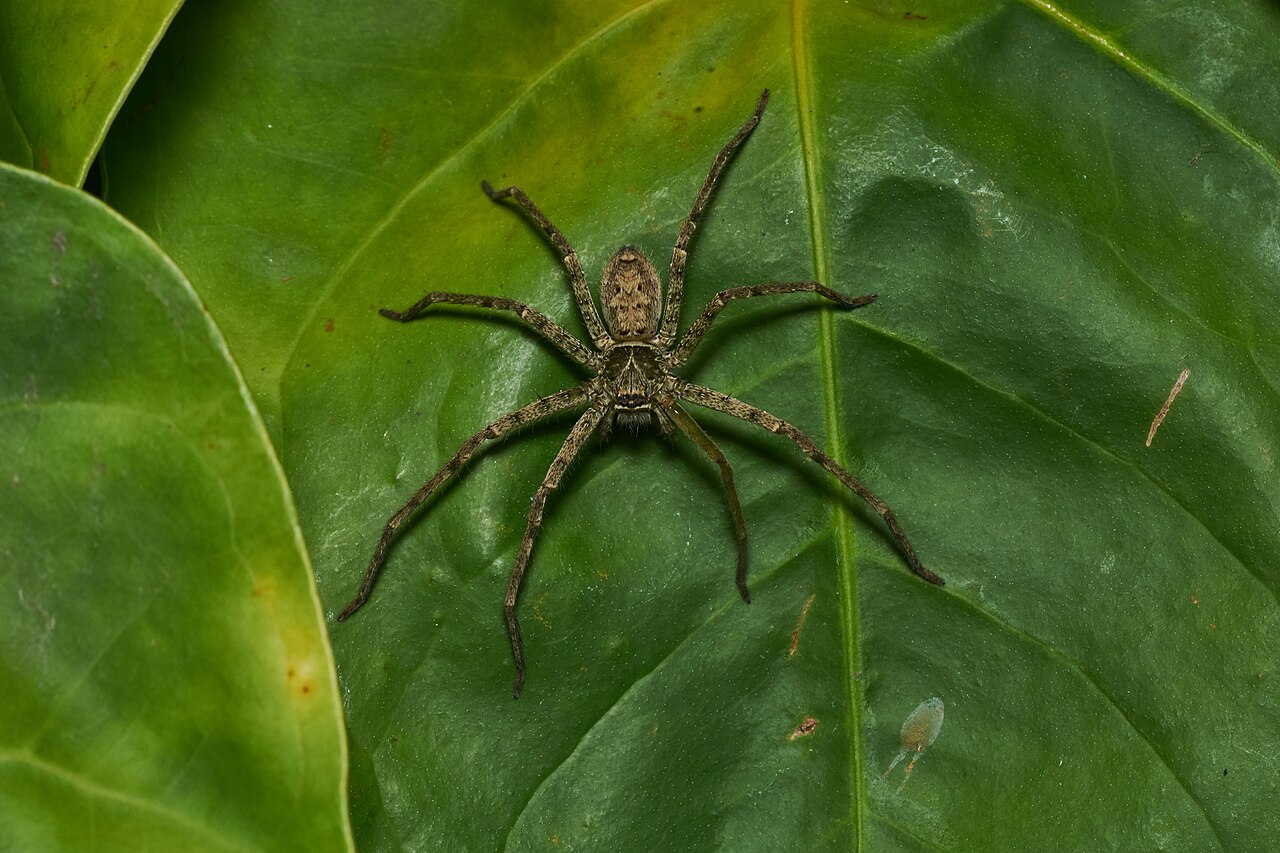
Photo: Jeevan Jose, Kerala, India, CC BY-SA 4.0
Spider
Intermediate
Heteropoda venatoria
Lifespan
F 1.5-3 years, M 1-1.5 years
Adult size
DLS 7-10 cm (body 2.2-2.8 cm)
Temperament
Skittish, extremely fast, escape-prone
Temperature
21–29°C
Humidity
55–75%
Vivarium
20 x 20 x 30 cm (arboreal, tall)
Wikipedia →
Found throughout the tropics and in heated buildings elsewhere, often in houses, barns and banana shipments, and occasionally arriving in the UK as a stowaway. A flat, long-legged brown spider with a cream band on the face and a leg span of 7-10 cm, built for speed on walls and bark. Keepers like its size, hardiness and active night-time hunting, but it is extremely fast and a real escape risk. The bite can be painful but is not considered dangerous.
Care information is provided for educational purposes only and does not replace professional veterinary advice.
🔥 Heating
Keep at about 24-27 °C, the range used in laboratory rearing; normal room temperature works in a warm home. If needed, fit a heat mat to the side or back on a thermostat to give a gentle gradient.
💡 Lighting
Nocturnal, so no special lighting or UVB is needed; normal room daylight provides the day/night cycle.
🪨 Substrate
3-5 cm of slightly moist coco fibre or soil mix; it lives on vertical surfaces, so substrate mainly helps hold humidity.
🍽 Feeding
Spiderlings: fruit flies and small crickets two or three times a week. Juveniles: mealworms, flies or crickets every few days; adults: crickets or roaches about a third to half of their body length once or twice a week.
💧 Water
Mist lightly every few days so it can drink droplets, and keep a shallow water dish; never let spiderling enclosures dry out completely.
🏠 Enrichment
Flat cork bark slabs leaned diagonally or fixed against the back to make narrow crevices, with enough open height to moult hanging upside down.
🩺 Health Considerations
It moults hanging upside down, so a fall or disturbance during a moult can be fatal; leave space at the top and remove uneaten prey. Dehydration and poor ventilation are the other common problems.
🤲 Handling
Hands-off recommended: it is extremely fast, bolts at any opening and its long legs are easily damaged. Move it with a catch cup or by container-to-container transfer; defensive bites are rare and painful but not medically significant.
⚖️ Legal Restrictions
No licence needed in the UK. Huntsman spiders are not on the Dangerous Wild Animals Act 1976 schedule (which lists only Phoneutria, Atrax, Loxosceles and Latrodectus spiders), and this species is not CITES-listed or a GB invasive species of special concern. As a non-native animal it must never be released (Wildlife and Countryside Act 1981, section 14).
📋 Additional Notes
Sexing: males have longer legs, enlarged pedipalp tips and a cream (not tan) band behind the eyes; females are slightly larger, especially the abdomen, and carry a flat egg sac under the body. In a laboratory study they took about a year to mature, males lived 355-586 days and females 298-710 days, and some adult females reached about 3 years. Other huntsmen sold in the UK, such as Heteropoda lunula, H. boiei and H. davidbowie, need similar care.